

Kirk Stauss & the Stauss Realty Team, Okoboji, Iowa
Milford, Iowa: The Gateway to the Iowa Great Lakes
Milford, Iowa is a year-round city of 3,258 residents at the southern end of the Iowa Great Lakes, with its own schools, utility, airport and parks, and homes priced below the county median.
Milford in figures · U.S. Census Bureau
Overview
Why live in Milford, Iowa?
Milford, Iowa is a year-round city of an estimated 3,258 residents at the southern end of the Iowa Great Lakes, on U.S. Highway 71, where 1,561 of 1,759 homes are occupied all year. It calls itself “The Gateway to the Iowa Great Lakes,” and it is one of the nine Iowa Great Lakes communities Stauss Realty covers.
Milford is the second-largest town in our area, after Spirit Lake, and it works like one. The city runs its own electric and water utility, has its own police and fire departments, a library, a community center, five parks and a municipal airport, and it is home to all three schools of the Okoboji Community School District. People live here for the same reasons people live in any good small town: work, school, family and a reasonable price.
The lakes are close, but Milford is not a lake-resort town. Its housing is overwhelmingly year-round, its population is the youngest of the communities we cover, and its median home value of $218,400 sits well below the county’s $270,700. If what you want is to live near the lakes rather than on them, Milford is often where that search ends up.
For buyers relocating to the area, our relocation services page covers buying from a distance. If you would rather be on the deep water, our Okoboji guide covers the other end of the spectrum.
Population: U.S. Census Bureau, Vintage 2024 estimates. Housing: American Community Survey five-year estimates, 2020-2024. Town details: City of Milford.
Location
Why is Milford called the gateway to the Iowa Great Lakes?
The short answer: because it sits at the southern end of the chain, where U.S. 71 arrives from the south and Iowa 86 heads up the west side of West Okoboji.
The City of Milford describes itself as being on the southern shores of the Iowa Great Lakes. In practice, most of the lake country lies to the north: Arnolds Park, Okoboji and Spirit Lake along U.S. Highway 71, and Wahpeton, West Okoboji and Iowa Lakeside Laboratory along Iowa Highway 86, which begins at U.S. 71 near Milford and runs up the lake’s west side.
Two pieces of infrastructure make that location work day to day. The Iowa Great Lakes Trail, the paved “Spine Trail,” runs about 14 miles from Milford’s Old Town north through Arnolds Park and Okoboji to Spirit Lake, largely on the old Milwaukee Road railbed. And Milford Municipal Airport (Fuller Airport) offers tie-downs and 24-hour self-service fuel, and the city notes it is busy with summer traffic.
To the southwest, the county’s Horseshoe Bend Recreational Area sits on a bend of the Little Sioux River, about five miles from town, with a canoe launch, primitive camping, mowed trails and winter tubing. Between the river, the trail and the lakes, Milford residents have a lot within a short ride.
Who Lives Here
Who lives in Milford?
The short answer: year-round households of every age: 1,561 of the city’s 1,759 homes are occupied, and its median age is the youngest of the towns we cover.
Of Milford’s 1,759 housing units, 1,561 (about 89%) are occupied. The Census estimate of seasonal homes is so uncertain that its margin of error is almost as large as the estimate, so we do not publish a percentage. The plain reading is enough: Milford is a town where people live, not one where they visit.
The 2020 Census recorded a median age of 41.0 in Milford, the youngest of the eight communities we cover and well below the county’s 49.1. The population was an estimated 3,258 in 2024, against 3,335 in 2020, a small decline that is within ordinary movement for a town this size.
Milford also has the largest rental market of the smaller towns: an estimated 466 of its 1,561 occupied homes are rented. That matters if you are moving here for work and want to rent before you buy, and it matters if you are weighing a rental property; our investment property page covers how we approach that.
U.S. Census Bureau: ACS five-year estimates 2020-2024 (B25002, B25003, B25004); 2020 Census (P13); Vintage 2024 population estimates.
Housing
What kind of homes are in Milford, and what do they cost?
The short answer: mostly year-round single-family homes with a median value of about $218,400 and a median construction year of 1983.
The Census estimate of the median value of an owner-occupied home in Milford is $218,400, with a margin of error of about $22,000, one of the tighter estimates in the area because the town is large enough to measure well. That is well under the county’s $270,700 and close to Spirit Lake’s $215,100.
The median year of construction is 1983, newer than the county’s 1979 and far newer than Lake Park’s 1961. In practice, that means a mix of older homes near the historic centre and newer neighbourhoods and subdivisions around it, with fewer of the seasonal cottages that define the lake towns.
For buyers, the attraction is a working-town price within reach of the lakes. For first-time buyers in particular, Milford is often where the numbers work; our mortgage pre-approval guide is the right place to start.
Town & Recreation
What does Milford offer residents?
The short answer: the full set of services of a working small city, from its own utility and airport to five parks and a community center.
Sources: City of Milford (services, parks, airport); TrailLink (trail); Dickinson County Conservation via Wikipedia (Horseshoe Bend); Iowa Lakeside Laboratory history. Hours, fees and seasons change; check with the operator before you plan around any of them.
Community Comparison
How does Milford compare with the other lake towns?
The short answer: it is the second-largest town in the table and one of the most year-round, with a mid-range price and the youngest population.
| Community | Population, 2024 | Housing units | Occupied | Seasonal-use share | Median home value |
|---|---|---|---|---|---|
| Milford | 3,258 | 1,759 | 1,561 | n/a | $218,400 |
| Wahpeton | 337 | 750 | 222 | 66.9% | $495,500 |
| West Okoboji | 311 | 444 | 230 | Close to half | n/a |
| Arnolds Park | 1,214 | 1,616 | 522 | 65.5% | n/a |
| Okoboji | 729 | 1,368 | 542 | 54.5% | n/a |
| Orleans | 503 | 625 | 273 | More than half | n/a |
| Lake Park | 1,155 | 586 | 514 | n/a | $168,800 |
| Spirit Lake | 5,548 | 2,881 | 2,716 | n/a | $215,100 |
| Dickinson County | 18,158 | 14,206 | 8,845 | 33.8% | $270,700 |
Population: U.S. Census Bureau, Vintage 2024 estimates (July 1, 2024). Housing: American Community Survey five-year estimates, 2020-2024. Where a cell shows n/a, the Census estimate for that community carries a margin of error too wide to publish responsibly. For Milford’s seasonal share, the margin is almost as large as the estimate. Small-town figures are ranges, not points.
Milford sits with Spirit Lake and Lake Park on the year-round side of the county. The second-home towns, Arnolds Park, Okoboji, Orleans, Wahpeton and West Okoboji, sit on the other. Milford and Spirit Lake are the two places in the county where a full-size working town and the lakes meet.
On the Market
Which Milford homes for sale are listed right now?
Milford, Iowa homes for sale, updated from the MLS feed that runs the rest of our site. A Milford mailing address also covers some homes north of town toward the lakes, so check the map for where each home sits.
Milford
Schools
What schools are in Milford?
The short answer: Milford is home to the Okoboji Community School District’s elementary, middle and high schools, but verify the attendance boundary by parcel.
We publish no ratings, no test scores and no rankings. Those figures change annually, differ sharply by source, and reduce a school to a number that says little about whether it suits a particular child.
The Okoboji Community School District was formed on July 1, 1988, by merging the Arnolds Park and Milford districts, according to Iowa Department of Education records. Its elementary, middle and high schools are listed in Milford, and the city describes itself as home of the Okoboji Pioneers. For families, having every grade in town is a practical advantage over the smaller lake towns.
For the boundary, the Iowa Department of Education publishes an official boundary map for every public school district in the state, drawn from the 2025-2026 School District Review Program conducted with the U.S. Census Bureau. District boundaries do not follow city limits, and rural land around Milford may fall in a neighbouring district. Verify by parcel.
Before You Buy
What should you check before buying in Milford?
The short answer: the house itself, the utilities, the city’s permit rules and, outside town, the septic and well.
Closing in Iowa
Why is closing in Iowa different?
The short answer: Iowa uses an abstract-and-attorney system rather than the conventional title insurance most states rely on.
Rather than a title insurance policy, the abstract of title (the running documentary history of the property) is brought up to date and examined by an attorney, who issues a title opinion. Iowa also requires a groundwater hazard statement, and where a private septic system serves the property, the time-of-transfer inspection described above.
In Milford, where many purchases are financed by people living or working in the area, the lender’s appraisal and the home inspection usually set the pace as much as the abstract does. Our buyer’s agent services page covers the full sequence, from pre-approval and earnest money to closing day.
General information about local practice, not legal advice. Statutory requirements change; confirm current requirements with your closing attorney and the county.
Through the Year
What is a year in Milford really like?
The short answer: a full-time town all year, with the lake season adding traffic and energy from Memorial Day to Labor Day.
Milford does not empty in winter. With about 89% of its homes occupied year-round, its rhythm follows the school calendar and the working week rather than the tourist season.
Summer is when the town is busiest: traffic on U.S. 71 heading north to the lakes, planes at the airport, bikes on the Spine Trail and campers at Horseshoe Bend. Autumn brings school sports and the quieter lake season that many locals name as their favourite.
Winter is a real Iowa winter: snow, wind and a long cold season, with tubing and skiing at Horseshoe Bend and a town that keeps working through it. If you want lake access without living in a place that is half empty from October to May, that difference is the point of Milford. It is also why Milford suits people who work locally: the town you see on a July weekend and the town you see on a Tuesday in January are the same place, with the same neighbours, the same school run and the same open shops.
Selling
What if you’re selling in Milford?
The short answer: your buyer is most likely a local or relocating household with a loan, so condition, presentation and a realistic price do most of the work.
Milford has one of the deeper resale markets in the area, because it has more year-round homes than any town except Spirit Lake. That means more genuinely comparable sales, and pricing that can be grounded in evidence rather than guesswork.
Many buyers will be financing, so the appraisal and inspection are where a sale is won or lost. Gather receipts for the roof, furnace, water heater, windows and any permitted additions, and think about which small repairs are worth doing before you list.
Our seller’s agent services page sets out how we approach pricing, preparation and Iowa’s seller disclosure requirements, and our guide to marketing your home covers presentation.
Why Stauss Realty
Why work with a local brokerage in Milford?
The short answer: because Milford is where many buyers find the balance between the lakes and everyday life, and judging that balance well is local work.
A buyer looking at Milford is usually also looking at Spirit Lake, Arnolds Park or Okoboji, and the right answer depends on schools, commute, budget and how close to the water you really need to be. A local agent who works all of those towns can compare them honestly.
Stauss Realty is based in Okoboji, a short drive up U.S. 71, and works across Milford and the whole Iowa Great Lakes chain. Our agents have spent their lives here, and we hold a 4.9-star Google rating.
Your Agent
Who is Kirk Stauss, and how does he help people buying or selling in Milford?
The short answer: Kirk Stauss is the broker and founder of Stauss Realty, with an office in Okoboji, and he has helped people buy and sell on the Iowa Great Lakes for nearly 30 years. Milford is one of the nine Iowa Great Lakes communities he and his team of lifelong locals serve.
Who is Kirk Stauss in Milford real estate?
A local broker a few miles up the highway:
- Broker and founder of Stauss Realty, based at 1003 Hwy 71 South, Okoboji
- Nearly 30 years buying and selling on the Iowa Great Lakes
- Works the year-round towns as well as the lakefront
What does Kirk do for Milford buyers and sellers?
The practical work of a transaction here:
- Compares Milford honestly with Spirit Lake, Arnolds Park and Okoboji
- Prices homes from real local comparables
- Coordinates inspection, appraisal and closing dates
- Requests disclosures, permits and HOA documents for you and your advisers to review
Who does Kirk help with Milford real estate?
The buyers and sellers this page is written for:
- Families who want every grade of the Okoboji schools in town
- First-time buyers looking for a working-town price near the lakes
- Households relocating to the area for work
- Milford sellers whose buyers are financing
What Milford real estate problems does Kirk solve?
The ones specific to this town:
- Confirming whether a Milford-addressed property is inside city limits
- Checking that past additions and decks were permitted
- Planning around appraisal and inspection timelines
- Sequencing septic and well checks on rural properties
- Choosing between Milford and the lake towns on facts, not impressions
What does Kirk specialize in around Milford?
Named areas of focus:
- Year-round family homes
- First-time buyers
- Relocation purchases
- Seller representation and pricing
Why work with Kirk Stauss on Milford real estate?
Because the right town matters as much as the right house:
- Nearly 30 years helping people buy and sell on the Iowa Great Lakes
- Broker and founder of Stauss Realty, with an office in Okoboji and a team of lifelong locals
- A 4.9-star Google rating (verified September 2026)
- Serves nine Iowa Great Lakes communities, so if another town suits you better than Milford, you will hear it plainly
The Area
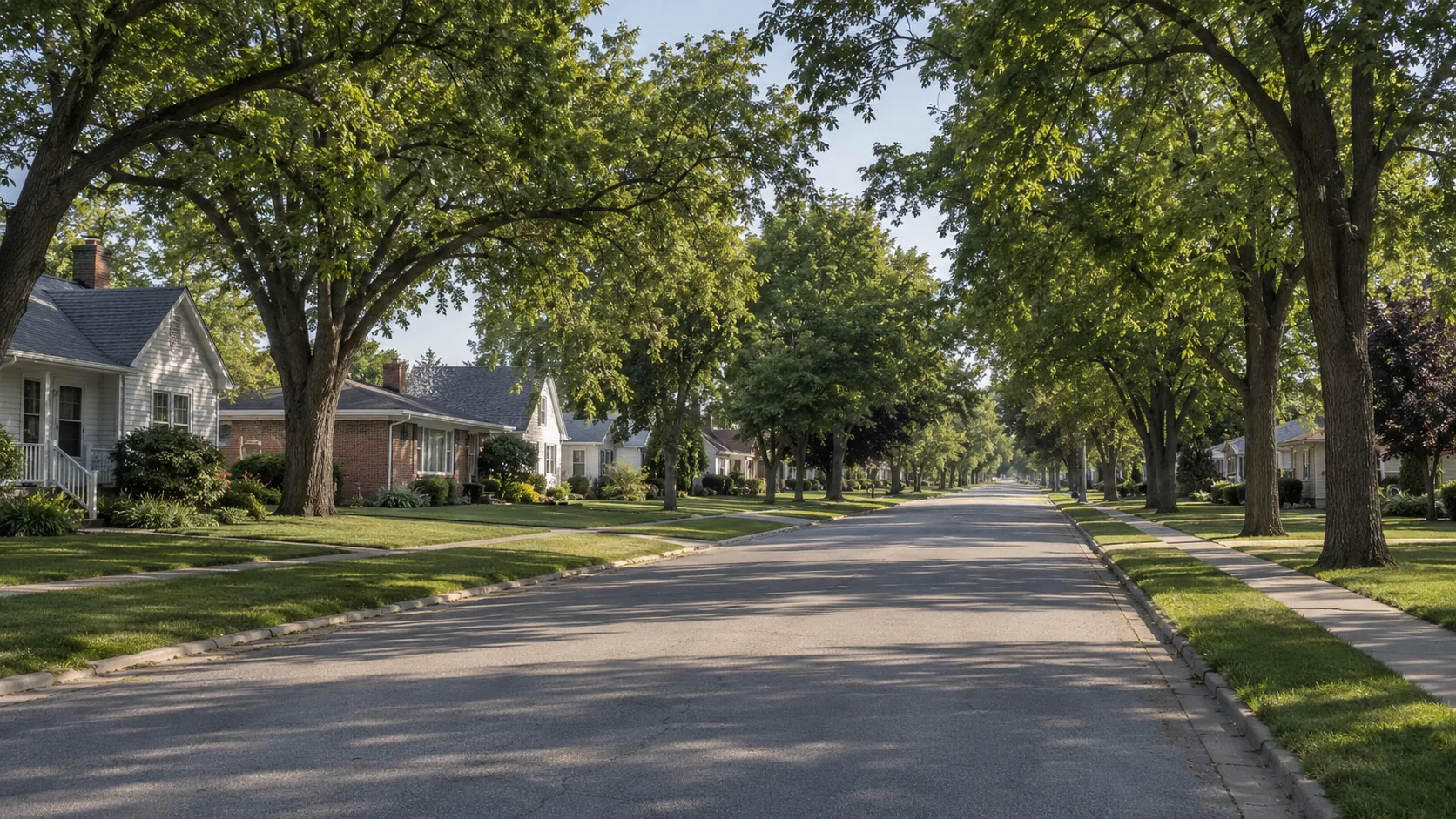
What does Milford look like?
Year-round streets, the trail north and the lakes a few minutes away.
Year-round streets
About 89% of Milford’s homes are occupied year-round, the life of a working town.
Questions
What do buyers ask most?
The short answer: it is a full-size year-round town within a short drive of the lakes. An estimated 3,258 people lived there in 2024, about 89% of its homes are occupied all year, and the Census median value of an owner-occupied home is about $218,400, well below the county’s $270,700. It has its own utility, police and fire departments, five parks, a library, an airport and all three Okoboji Community schools, plus the start of the Iowa Great Lakes Trail.
The short answer: at the southern end of the Iowa Great Lakes in Dickinson County, on U.S. Highway 71. The city calls itself the Gateway to the Iowa Great Lakes. Iowa Highway 86 begins at U.S. 71 near Milford and runs up the west side of West Okoboji, while U.S. 71 continues north through Arnolds Park and Okoboji to Spirit Lake. The Little Sioux River runs to the southwest, at Horseshoe Bend.
The short answer: an estimated 3,258 residents in 2024, against 3,335 in 2020, per U.S. Census Bureau Vintage 2024 estimates. That makes it the second-largest of the communities we cover, after Spirit Lake at 5,548. It has 1,759 housing units, of which 1,561 are occupied. It is large enough to have the full set of small-city services and small enough to feel like a town.
The short answer: yes. About 89% of its homes, 1,561 of 1,759, are occupied, and the Census estimate of seasonal homes is too uncertain to publish. The 2020 Census median age was 41.0, the youngest of the eight communities we cover. Milford follows the school year and the working week rather than the tourist season, which is the main difference from the lake towns to the north.
The short answer: the Census estimate of the median value of an owner-occupied home is about $218,400, with a margin of error of roughly $22,000, from American Community Survey five-year estimates for 2020-2024. That is below the Dickinson County median of $270,700 and close to Spirit Lake’s $215,100. Individual prices depend on size, condition and neighbourhood, and we quote real figures for real properties.
The short answer: the median year of construction is 1983, per American Community Survey five-year estimates for 2020-2024, newer than the county’s 1979. Expect older homes near the historic centre and newer neighbourhoods around them. Many homes are due for second-generation roofs, furnaces and windows, so a thorough inspection matters, and homes built before 1978 bring the federal lead-based paint disclosure.
The short answer: the Okoboji Community School District’s elementary, middle and high schools are listed in Milford, and the city calls itself home of the Okoboji Pioneers. The district was formed in 1988 by merging the Arnolds Park and Milford districts. We publish no ratings, scores or rankings. The Iowa Department of Education publishes official boundary maps; verify the boundary for the specific parcel, since district lines do not follow city limits.
The short answer: yes. Milford Municipal Utilities provides electric and water service in the city, and the city runs its own police, fire and public works departments. Garbage is collected weekly, with recycling on alternating weeks. Ask for a property’s recent utility bills before you buy; they are the most reliable guide to what a house costs to run through an Iowa winter.
The short answer: the City of Milford’s history records A.D. Inman as the first settler in Milford Township in 1866, and the town plat filed at the Dickinson County Courthouse on August 21, 1882. Residents petitioned for incorporation in December 1891, the election was held on January 11, 1892, and the first town council met on March 14, 1892, under the first mayor, W.F. Pillsbury.
The short answer: the city lists five parks, a community center and the Milford Memorial Library. The paved Iowa Great Lakes Trail starts in Milford’s Old Town and runs about 14 miles north to Spirit Lake. Horseshoe Bend Recreational Area, about five miles southwest on the Little Sioux River, has a canoe launch, camping, trails and winter tubing. The lakes, Iowa Lakeside Laboratory and Gull Point State Park are a short drive north.
The short answer: the city describes itself as being on the southern shores of the Iowa Great Lakes, and most of the chain lies just to the north. Many homes in Milford are in town rather than on the water, which is part of why prices are lower than on the lake. Some properties with Milford mailing addresses are actually on the west side of West Okoboji, often in Wahpeton or the City of West Okoboji, so confirm the jurisdiction for any lake listing.
The short answer: whether the property is inside city limits, since a Milford mailing address covers a wide area. Then check utility history, permits for past additions, decks and basement bedrooms, and the condition of roofs, furnaces and windows. Outside town, confirm septic and well arrangements; Iowa requires a time-of-transfer inspection on septic systems before the deed can be recorded. Get pre-approved early, since many purchases are financed.
The short answer: many families choose it because every grade of the Okoboji Community School District is in town, the population is the youngest of the communities we cover, and the city has parks, a library and a community center. It is also year-round, so the neighbourhood you see in July is the one you will have in January. Visit the schools and neighbourhoods yourself; we publish no school ratings.
The short answer: Iowa closes on an abstract-and-attorney system rather than the conventional title insurance used in most states: the abstract of title is updated and examined by an attorney, who issues a title opinion. Add Iowa’s groundwater hazard statement, and a septic time-of-transfer inspection where a private system is involved. On a financed purchase the appraisal and inspection timing matter just as much, and we set the timetable out at the start.
The short answer: your buyer is most likely a local or relocating household with a loan, so condition, presentation and a realistic price do most of the work. Milford has more genuinely comparable sales than the small lake towns, which helps pricing. Gather receipts for major updates and permitted additions before you list. Our seller’s agent services page sets out how we approach pricing, preparation and Iowa’s disclosure requirements.
The short answer: Stauss Realty, based in Okoboji just up U.S. 71 and working across Milford and the whole Iowa Great Lakes chain, with a 4.9-star Google rating. Many Milford buyers are also weighing Spirit Lake, Arnolds Park or Okoboji, and an agent who works all of them can compare them honestly. Kirk Stauss has helped people buy and sell here for nearly 30 years. Start with a conversation, no obligation.
Let’s Talk
Thinking about a home in Milford? Send us a note and we will come back to you with current listings, recent sales, and straight answers about the town and how it compares with the lake towns.
By proceeding, you consent to be contacted by Stauss Realty about real estate related matters by phone, email, or text at the contact details provided, but not as a condition of purchase. Message frequency varies; message and data rates may apply; reply Stop to cancel.