
Kirk Stauss & the Stauss Realty Team: Okoboji, Iowa
Investment Property Buying & Sales in the Iowa Great Lakes
Investment property buying and sales here means buying or selling property that has to earn its keep. We handle the representation (the financing lane, what Iowa asks of you as a landlord, the short-term rental rules, and the exchange deadlines) and leave the investing decisions where they belong: with you and your advisors.
The mechanics that decide the deal · Fannie Mae, IRS, Iowa Code
Overview
What are investment property services in Okoboji, Iowa?
Representation for buying and selling property held to produce income: getting the financing classification right, understanding what Iowa law requires of a landlord before you become one, checking whether a short-term rental plan is actually permitted at that address, and coordinating a sale or a 1031 exchange to its deadlines. Stauss Realty provides that across Spirit Lake, Milford, Spencer, Arnolds Park, Okoboji, West Okoboji, Wahpeton, Orleans, Lake Park and the wider Iowa Great Lakes.
What this page is not: a pitch. We are a brokerage, not an investment adviser, and there is no audited rent or capitalisation-rate dataset for these lakes, so you will not find projected yields, rent estimates or appreciation forecasts here, because any we published would be invented. What you will find is the set of rules and mechanics that decide whether a deal works: how lenders classify investment property, what Iowa’s landlord-tenant law puts on your side of the ledger, where short-term rentals are and are not permitted, how the tax treatment differs from a home you live in, and the deadlines a 1031 exchange lives or dies by.
The lines between categories matter more here than most places, because so much of the housing stock is part-time. If the property is for your own use, see our second home buying services; if it is a getaway you will also rent out sometimes, our vacation home services cover that. The distinction is not cosmetic; it changes your down payment, your rate, and what you are allowed to do with the property.
The Market
What kind of demand does the Iowa Great Lakes area actually see?
The short answer: heavy seasonal visitation and a housing stock built around part-time use, which is context for a decision, not a forecast of what any property will earn.
The visitation figures are substantial and publicly reported. Direct visitor spending in Dickinson County reached $241.6 million in 2024, tourism supports over 1,400 area jobs, and the area drew more than 735,000 visitors between mid-May and Labor Day 2026, of whom 554,000-plus travelled at least 50 miles to get here.
The housing stock reflects it: 4,808 of Dickinson County’s 14,206 housing units (about 34%) are vacant for seasonal, recreational or occasional use. For an investor that cuts two ways. It signals genuine seasonal demand; it also means the year-round rental supply and the year-round tenant pool are both smaller than the raw housing count suggests, and that seasonal and annual strategies are quite different businesses.
Nationally, NAR put individual investors and second-home buyers at 14% of transactions in July 2026, a national figure, not a local one. Iowa’s statewide median single-family price was $280,000 that month with a median 16 days on market. We price and evaluate each property from current comparable sales rather than from a segment average, because no credible segment average exists for this market.
Sources: Dickinson County tourism and visitation figures as publicly reported; U.S. Census Bureau American Community Survey 2024 5-year estimates, table B25004, via Census Reporter; National Association of REALTORS July 2026 existing-home sales (national); Iowa Association of REALTORS; Tax Foundation county property-tax data. Nothing on this page is investment advice, and no return, rent level or appreciation is projected or implied.
What’s Included
What does investment property representation actually cover?
The short answer: five things: the financing lane, the compliance picture before you commit, the condition and tenancy due diligence, the offer or the listing, and a closing that meets whatever deadlines apply.
The financing lane, settled early
Investment property finances on different terms than a second home: Fannie Mae’s Eligibility Matrix caps a one-unit investment purchase at 85% loan-to-value against 90% for a second home, and unlike a second home, rental income may be used in qualifying. One to four units are permitted. Which lane you are in is decided by conditions, not intentions.
The compliance picture, before you commit
What Iowa’s Uniform Residential Landlord and Tenant Law will require of you: deposits, disclosures, notice periods, late-fee limits. Whether short-term rental is permitted at that address under the city ordinance and, separately, under any condo association (HOA) rules. Better known during due diligence than after closing.
Condition and tenancy due diligence
The building itself: roof, mechanicals, whether it is on the regional sewer or a private septic, the well, and on older stock, what the home inspection should chase hard. Plus, where a property comes tenanted: existing leases, deposits held, payment history and what transfers to you at closing, gathered for you and your attorney to review.
The offer, or the listing
Buying, an offer priced on comparable closed sales with contingencies that protect your earnest money while diligence runs. Selling, a listing that presents the property to the buyers who actually purchase this kind of asset, with the documentation those buyers ask for assembled before the sign goes up rather than scrambled for afterwards.
A closing that respects the deadlines
Iowa’s abstract-and-attorney title work (an attorney examines the abstract of title, the recorded history of the property’s ownership), the groundwater hazard statement, any time-of-transfer septic inspection, and, where a 1031 exchange is in play, a transaction sequenced around the 45-day identification and 180-day receipt deadlines in coordination with your qualified intermediary. Those dates are unforgiving, and the identification has to be in writing.
Financing
How is an investment property financed differently?
The short answer: more down and higher pricing than a second home, but rental income can help you qualify, and one to four units are on the table.
| Factor | Investment Property | Second Home |
|---|---|---|
| Maximum LTV on a purchase | 85% on a one-unit, so at least 15% down | 90%, so at least 10% down |
| Units permitted | One to four | One-unit dwellings only |
| Owner occupancy | Not required | Required for some portion of the year, with exclusive control |
| Rental income in qualifying | May be used, subject to the lender’s documentation rules | May not be used to qualify, even where renting is permitted |
| Management | A management company is normal and expected | Cannot be subject to an agreement giving a management firm control over occupancy |
| Pricing | Highest of the three occupancy classes | Above primary-residence pricing, below investment |
Sources: Fannie Mae Eligibility Matrix (August 5, 2026, Desktop Underwriter 12.1, incorporated by reference into the Selling Guide); Fannie Mae Selling Guide B2-1.1-01, Occupancy Types. Above the $832,750 2026 conforming limit for a one-unit property, financing moves to jumbo or other nonconforming terms. Portfolio, commercial and DSCR products sit outside these rules entirely. Confirm current terms and documentation requirements with your lender.
Which lane does your purchase actually fall into?
Investment property or second home is decided by occupancy, control and use, not by what you intend to call it. It sets your down payment, your rate and what you are allowed to do with the property, so it is worth settling before you write an offer.
Landlord Law
What does Iowa law require of you as a landlord?
The short answer: more than most first-time landlords expect: deposits are capped and must be segregated, the clock on returning them is thirty days, late fees are limited by statute, and several disclosures have to be in writing before the tenancy starts.
| Obligation | What Iowa Requires | Citation |
|---|---|---|
| Security deposit cap | May not demand or receive more than two months’ rent | § 562A.12(1) |
| Holding the deposit | Held for the tenant in a federally insured bank, savings and loan or credit union; not commingled with the landlord’s personal funds. May be a common, interest-bearing trust account; interest in the first five years is the landlord’s | § 562A.12(2) |
| Returning the deposit | Thirty days from termination and receipt of the tenant’s mailing address to return it or furnish a written statement of the specific reason for withholding; damages must be specified | § 562A.12(3) |
| Grounds for withholding | Only three: unpaid rent or other funds due; restoring the unit to its condition at commencement, ordinary wear and tear excepted; recovering possession from a tenant not acting in good faith. The landlord carries the burden of proof | § 562A.12(3) |
| Late fees | Rent $700/month or less: max $12/day or $60/month. Rent above $700: max $20/day or $100/month | § 562A.9(4) |
| Default tenancy term | Where no definite term is fixed: week-to-week for a roomer paying weekly, month-to-month otherwise | § 562A.9(5) |
| Written disclosure | Name and address of the manager, and of an owner or agent for service of process, disclosed in writing at or before commencement, and kept current | § 562A.13(1)-(2) |
| If you fail to disclose | The non-complying person becomes an agent of each landlord for service of process and for performing the landlord’s obligations, applying rent collected to that purpose | § 562A.13(3) |
| Utilities | Rates, charges and services must be fully explained before the agreement is signed, unless the tenant pays the utility directly | § 562A.13(4) |
| Rent increases | At least thirty days’ written notice, effective no sooner than the expiration of the agreement or any renewal | § 562A.13(5) |
Source: Iowa Code chapter 562A, Uniform Residential Landlord and Tenant Law, § 562A.9, § 562A.12, § 562A.13 (Iowa Code 2026, official text). This table covers frequently missed obligations and is not a complete statement of the chapter; notice, entry, maintenance and termination provisions are not reproduced here. General information, not legal advice: have an Iowa attorney draft your lease and advise on your situation.
Short-Term Rental
Can you run an Iowa Great Lakes property as a short-term rental?
The short answer: Iowa law stops cities from banning short-term rentals, but an HOA can still ban them, so the answer depends on the specific address and its documents.
What Iowa protects (Iowa Code § 414.1)
What this means for you: the city cannot simply prohibit it or charge you a short-term rental licence fee.
Iowa Code § 414.1 provides that a city may not prohibit short-term rentals or impose short-term rental licence fees, and classifies short-term rental property as residential land use. The definition reaches a single-family house or dwelling unit, a unit in a condominium, cooperative or timeshare, or an owner-occupied residential home offered for a fee for thirty days or less. Cities keep their ordinary health, safety and nuisance authority, which is not nothing: occupancy, parking, noise and life-safety rules still apply.
What an HOA can still do
What this means for you: the declaration and bylaws are where short-term rental plans most often die.
State law restrains cities, not private governing documents. A condominium or amenity-community association can restrict rentals, impose minimum stay requirements, cap the number of units rented at one time, or prohibit short-term rental outright. Those rules sit in the declaration, bylaws and any adopted rules, which is why we request the HOA package for you and your attorney to review during due diligence rather than after closing. Our Okoboji condo page covers the HOA documents in depth.
The tax that comes with it
What this means for you: short stays carry lodging tax, and who remits it depends on how you book.
Iowa lodging tax applies: a 5% state excise plus a local hotel/motel tax of up to 7%, with rentals to the same person exempt only after ninety consecutive days. Book through a lodging marketplace and the marketplace collects and remits; rent directly and that obligation is yours. Rental income is separately taxable for federal purposes whether received as cash, property or services.
Sources: Iowa Code § 414.1 (official text, verified verbatim); Iowa Department of Revenue lodging-tax guidance; IRS Topic No. 414. General information, not legal or tax advice. Verify the current city ordinance and the association’s documents for the specific address before you rely on a rental plan.
Tax Mechanics
How is investment property taxed differently from a home?
The short answer: rental income is taxable, most operating expenses are deductible, the building is depreciated over 27.5 years, and that depreciation comes back at you when you sell.
Income and expenses
What this means for you: the gross rent is not the number that matters.
The IRS puts it plainly: cash, or the fair market value of property or services you receive for the use of real estate, is taxable to you as rental income. Against that, in general you can deduct the expenses of renting the property. Losses may then be limited by the passive activity and at-risk rules, the shape of which depends on your participation and your wider tax picture, so it is a conversation for your accountant rather than a rule we can state for you.
Depreciation, and recapture
What this means for you: the deduction is real, and so is the bill on the far end.
Residential rental property is generally depreciated over 27.5 years, straight line, using a mid-month convention under MACRS, beginning when the property is placed in service and reported on Form 4562. The part people underestimate is the exit: depreciation allowed or allowable is recaptured when you sell, whether or not you actually claimed it. Plan the exit at the same time as the entry.
Property tax, and what a rental does not get
What this means for you: Dickinson County’s rate helps, but the homestead exemption is not available here.
Dickinson County’s effective property-tax rate of 0.78% is tied for the lowest in Iowa, roughly half the 1.40% statewide rate. But Iowa’s homestead exemption requires the owner to occupy the dwelling as a home on July 1 and for at least six months of the calendar year, so an investment property does not qualify. Iowa’s real estate transfer tax also shows up in the seller’s closing costs at $0.80 per $500 of price above the first exempt $500.
Sources: IRS Topic No. 414, Rental income and expenses; IRS Publication 527, Residential Rental Property, and Publication 925, Passive Activity and At-Risk Rules; Tax Foundation county property-tax data; Iowa Code § 425.11; Iowa Code chapter 428A. General information, not tax advice.
1031 Exchanges
How does a 1031 exchange work, and what are the deadlines?
The short answer: two clocks start the day you transfer the property you are giving up: 45 days to identify the replacement in writing, 180 days to receive it, and neither clock is negotiable.
| Requirement | What the Rule Says | Where It Trips People |
|---|---|---|
| What qualifies | Real property only. The Tax Cuts and Jobs Act limited section 1031 to exchanges of real property for exchanges completed after December 31, 2017 | Personal and intangible property no longer qualify at all |
| Identification window | 45 days after the property given up is transferred, to identify the replacement property | It runs from the transfer, not from when you start looking; line up candidates before closing |
| Receipt window | 180 days, or the due date of your tax return including extensions, whichever is earlier | A late-year sale can shorten the window well below 180 days |
| Form of identification | Must be in writing, signed by you, and delivered to a person involved in the exchange: the seller of the replacement property or the qualified intermediary | A verbal shortlist is not an identification |
| Excluded property | Real property held primarily for sale does not qualify; a personal residence does not qualify | How the property has actually been held and used governs, not what you call it |
| Location | United States real property is not like-kind to real property outside the United States | Cross-border swaps fail the test |
Sources: Internal Revenue Service, Like-kind exchanges: real estate tax tips; Instructions for Form 8824, Like-Kind Exchanges; Tax Cuts and Jobs Act § 13303(c). General information, not tax advice. A qualified intermediary must be engaged before the relinquished property closes; our role is to sequence the transaction around your intermediary’s and your tax adviser’s requirements, not to give the advice.
Representation, Compared
What does having your own agent change on an investment purchase?
The short answer: five things: how the loan is classified, whether the rental plan is actually permitted, whether the leases reach you and your attorney before closing, how the offer or listing is priced, and whether the exchange deadlines get managed or missed.
| Factor | On Your Own | With Stauss Realty |
|---|---|---|
| Financing lane | Discovered at underwriting | Established up front against Fannie Mae’s occupancy rules: 85% versus 90% LTV changes the cash you need |
| Rental permission | City ordinance checked, HOA documents assumed | Both requested and delivered for your review, because state law restrains the city but not the HOA |
| Tenancy diligence | Leases taken at face value | Leases, deposit records, payment history and what actually transfers at closing, gathered for you and your attorney to review |
| Pricing | A yield figure from somewhere | Comparable closed sales, and an honest statement that no audited cap-rate dataset exists for these lakes |
| Exchange timing | Intermediary engaged after closing, too late | Transaction sequenced around the 45- and 180-day clocks with your intermediary from the start |
How We Work
How do we run an investment property transaction?
The short answer: in three phases: establish the constraints, verify the property and its paperwork, then transact to the deadlines.
Establish the constraints
What is actually possible, before anyone gets attached to a building.
- Financing lane and down payment, against the occupancy rules
- Long-term tenancy or short-term rental: genuinely different businesses
- What Iowa’s landlord-tenant law will require of you
- Written agreement: services and compensation on paper up front
Verify the property and the paperwork
Condition decides more deals than spreadsheets do.
- Roof, mechanicals, sewer or septic, well, and older-stock inspection priorities
- Existing leases, deposits held, payment history, what transfers at closing
- City ordinance and HOA documents on rental restrictions, requested for your review
- Comparable closed sales; no invented yield figures
Transact to the deadlines
Priced on evidence, closed on time, remotely if you prefer.
- Offer or listing priced from comparables, with protective contingencies
- Exchange sequencing around the 45- and 180-day clocks, with your intermediary
- Abstract, attorney title opinion, groundwater hazard statement, any septic inspection
- A closing you can complete from wherever you live
Why Stauss Realty
Why work with a local agent on investment property?
The short answer: because the constraints that decide these deals (HOA rules, city ordinances, septic and well questions, the leases already in place) are local and checkable, and because we will tell you when a number cannot be honestly produced.
The team’s background and approach are detailed on the About Stauss Realty page, with client words on the testimonials page. Stauss Realty is a licensed Iowa real estate brokerage, not an investment adviser, tax adviser or law firm. Nothing on this page is investment, tax or legal advice; no return, rent level or appreciation is projected or implied; and no specific outcome is promised.
About Kirk Stauss
Who is Kirk Stauss, and how does he help investment property buyers and sellers?
The short answer: Kirk Stauss is the broker and founder of Stauss Realty, with an office in Okoboji, and he has helped people buy and sell on the Iowa Great Lakes for nearly 30 years. On investment property, he and his team handle the representation on either side of the deal and leave the investing, tax and legal decisions with you and your advisors.
Who does Kirk help with investment property?
Buyers and sellers of income-producing residential property across the lakes.
- Buyers adding a long-term rental in an in-town market like Spirit Lake or Milford
- Buyers planning a short-term rental who need the city ordinance and HOA rules in hand first
- Owners selling a tenanted property who need leases and deposit records assembled before listing
- Sellers and buyers working through a 1031 exchange with the 45-day identification clock running
- Buyers still deciding whether a purchase finances as a second home or an investment property
What investment property problems does Kirk solve?
The rules and deadlines that decide more deals than projections do.
- Finding out at underwriting that a one-unit investment purchase needs 15% down, not 10%
- A short-term rental plan that an HOA’s declaration or bylaws can still ban even though the city can’t
- Leases, deposit records and payment history arriving mid-contract instead of during due diligence
- A qualified intermediary engaged after closing, when the exchange can no longer be saved
- Septic, well and older-stock condition questions that surface only after the offer
Why work with Kirk Stauss on investment property?
Local, checkable answers, and a plain answer when a number can’t honestly be produced.
- Nearly 30 years helping people buy and sell on the Iowa Great Lakes
- Representation on both sides: buying and selling
- An office in Okoboji and a team of lifelong locals across 9 Iowa Great Lakes communities
- A 4.9-star Google rating, verified September 2026
Where
What kinds of investment property trade here?
From in-town duplexes to lake condos, each with a different rule set behind it.
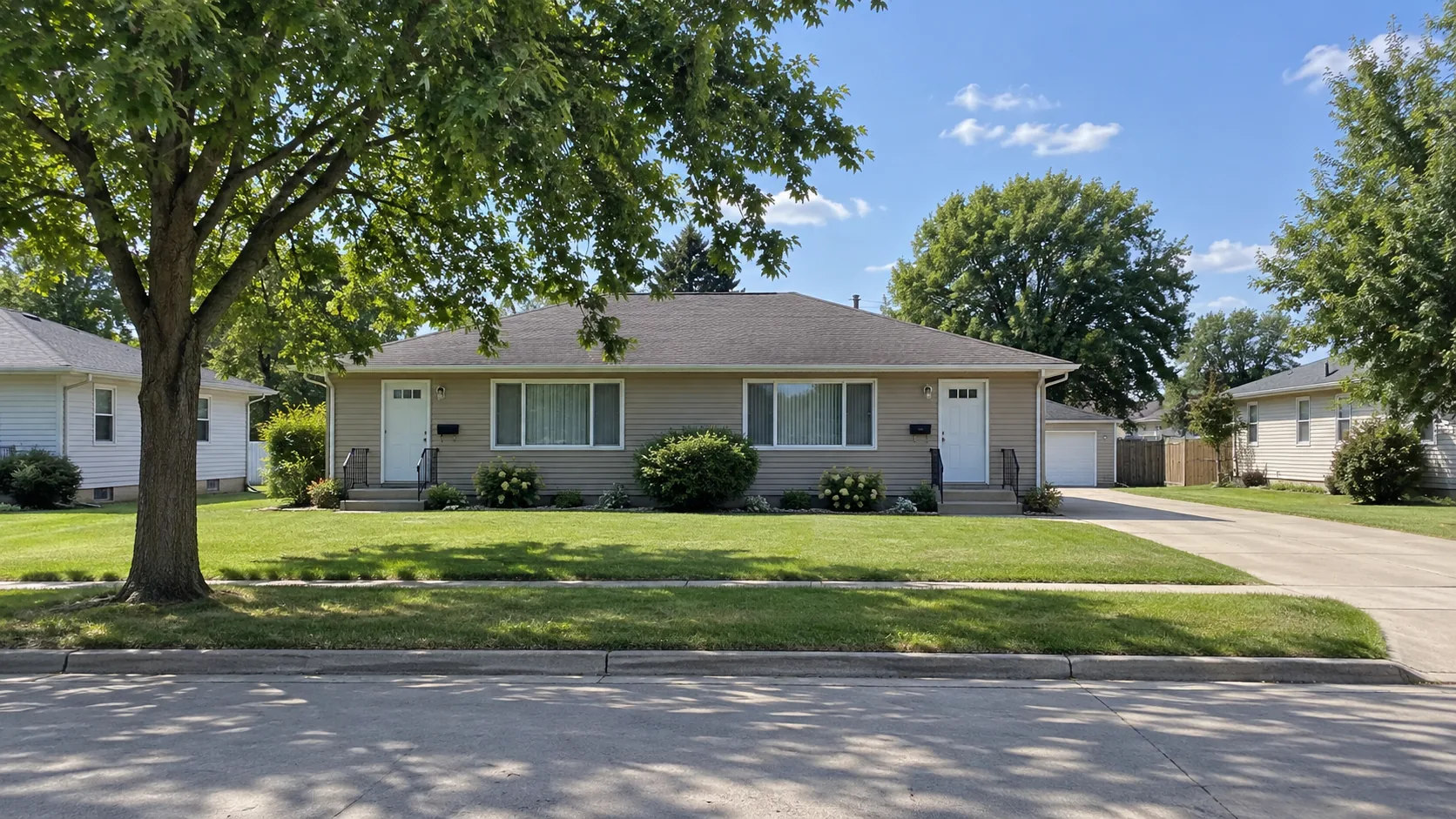
The rental on a side street
Long-term tenancies in town run on Iowa’s landlord-tenant law: deposits capped, notice periods fixed, disclosures required in writing.
Questions
What do investment buyers ask most?
The short answer: representation on either side of an income-property transaction: establishing the financing lane, reviewing what Iowa’s landlord-tenant law will require of you, checking whether short-term rental is actually permitted at that address, running condition and tenancy due diligence, pricing the offer or the listing on comparable closed sales, and closing to whatever deadlines apply, including a 1031 exchange. What it does not include is investment advice: we are a brokerage, not an adviser, and we publish no rent, yield or appreciation projections.
The short answer: generally at least 15% on a one-unit purchase. Fannie Mae’s Eligibility Matrix caps a one-unit investment-property purchase at 85% loan-to-value, against 90% for a second home. One to four units are eligible for conventional financing, and above the 2026 conforming limit of $832,750 for a one-unit property you are into jumbo or other nonconforming terms. Portfolio, commercial and debt-service-coverage products sit outside these rules altogether. Confirm current terms with your lender at pre-approval.
The short answer: on an investment property, yes, subject to your lender’s documentation requirements. That is one of the real differences from a second home, where Fannie Mae permits rental income on the property but does not allow the borrower to use it for qualifying. Expect to document leases, and expect the lender to apply its own vacancy and expense treatment rather than taking gross rent at face value.
The short answer: quite a lot, and it is all in the Uniform Residential Landlord and Tenant Law at Iowa Code chapter 562A. Among the obligations that catch new landlords: a security deposit may not exceed two months’ rent and must be held in an insured institution without commingling; deposits must be returned, or a written statement of the specific reason for withholding furnished, within thirty days of termination and receipt of the tenant’s mailing address; late fees are capped by statute; the manager’s and owner’s names and addresses must be disclosed in writing at or before the start of the tenancy; and rent increases require at least thirty days’ written notice. General information, not legal advice. Have an Iowa attorney draft your lease.
The short answer: no more than two months’ rent. Iowa Code § 562A.12 provides that a landlord shall not demand or receive a security deposit in excess of that, and the deposit must be held for the tenant in a federally insured bank, savings and loan or credit union, and shall not be commingled with the landlord’s personal funds. It may sit in a trust account, which may be common and may be interest-bearing, and any interest earned during the first five years of a tenancy belongs to the landlord.
The short answer: within thirty days of the termination of the tenancy and your receipt of the tenant’s mailing address or delivery instructions, you must either return the deposit or furnish a written statement showing the specific reason for withholding any of it, and if the withholding is for restoring the unit, the statement must specify the nature of the damages. Iowa Code § 562A.12 permits withholding only to remedy unpaid rent or other funds due, to restore the unit to its condition at the start of the tenancy with ordinary wear and tear excepted, or to recover the cost of getting possession from a tenant not acting in good faith. In a dispute the burden of proof is on the landlord.
The short answer: yes, but Iowa caps it by statute and the cap depends on the rent. Under Iowa Code § 562A.9, where rent is $700 per month or less, a rental agreement may not provide for a late fee exceeding $12 per day or $60 per month in total. Where rent is above $700 per month, the limits are $20 per day and $100 per month. A lease clause that exceeds those figures is not enforceable as written.
The short answer: at least thirty days in writing. Iowa Code § 562A.13 requires each tenant to be notified in writing of any rent increase at least thirty days before its effective date, and that effective date cannot fall sooner than the expiration of the original rental agreement or any renewal or extension. The same section also requires you to disclose the manager’s and owner’s names and addresses in writing at or before the start of the tenancy, and to fully explain utility rates and charges before the agreement is signed unless the tenant pays the utility directly.
The short answer: often yes, because Iowa law is unusually protective of short-term rentals, but the city is not the only gatekeeper. Iowa Code § 414.1 provides that a city may not prohibit short-term rentals or charge short-term rental licence fees, and classifies them as residential land use, while leaving cities their normal health, safety and nuisance authority. An HOA, however, can still restrict or ban rentals through its declaration and bylaws, and those documents are where a plan most often dies. Read them during due diligence.
The short answer: Iowa lodging tax applies to short stays (a 5% state excise plus a local hotel/motel tax of up to 7%), with rentals to the same person exempt only after ninety consecutive days. If you rent through a lodging marketplace, the marketplace collects and remits those taxes; rent directly and the obligation is yours. Federal income-tax treatment follows the IRS rental rules, and rental income is taxable whether you receive cash, property or services. General information, not tax advice.
The short answer: residential rental property is generally depreciated over 27.5 years using the straight line method and a mid-month convention under MACRS, beginning when the property is placed in service and reported on Form 4562. Depreciation is not optional in the way people sometimes assume: depreciation allowed or allowable is recaptured when you sell. Losses from rental activity may also be limited by the passive activity and at-risk rules. IRS Publications 527 and 925 set out the detail; work the actual numbers with a tax professional.
The short answer: a like-kind exchange under Internal Revenue Code section 1031 lets you defer gain by exchanging real property held for productive use in a trade or business or for investment. Two deadlines govern it and neither is flexible: you must identify the replacement property within 45 days of transferring the property you give up, and you must receive the replacement within 180 days or by your tax return’s due date including extensions, whichever is earlier. The identification must be in writing, signed by you, and delivered to someone involved in the exchange such as the qualified intermediary. Set the intermediary up before closing, not after.
The short answer: not for a personal residence, and not for property held primarily for sale. Since the Tax Cuts and Jobs Act amended section 1031 for exchanges completed after December 31, 2017, it applies only to exchanges of real property; personal and intangible property no longer qualify. Property held primarily for sale still does not qualify, and United States real property is not like-kind to real property outside the United States. Whether a mixed-use property qualifies depends on how it has actually been held and used, which is a question for your tax adviser, not your agent.
The short answer: occupancy, control and how the lender treats it. A second home must be a one-unit dwelling you occupy for some portion of the year, suitable for year-round occupancy, under your exclusive control, and not a rental-first property, a timeshare, or subject to an agreement giving a management firm control over occupancy. An investment property has no owner-occupancy requirement, can be one to four units, can be professionally managed, and can use rental income in qualifying, but requires more down and prices higher. Our second home page covers the other side of that line.
The short answer: yes, and out-of-area ownership is ordinary in this market, roughly a third of the county’s housing is seasonal or occasional-use, so remote transactions are routine for local lenders, closers and inspectors. Video tours, electronic signatures and remote closings are standard. Your agent handles the local work: showings, inspection access, gathering the leases and deposit records for your review, and the final walkthrough.
The short answer: condition first, because it decides more deals than income projections do: roof, mechanicals, whether the property is on the regional sewer or a private septic, the well, and on older stock what the inspection should chase hard. Then the paperwork: existing leases and their terms, deposits held and where, payment history, any HOA rules limiting rentals, and the city’s position on short-term rental if that is the plan. Then the numbers, which are yours and your accountant’s to run.
The short answer: yes. This is a two-sided service. On the listing side the work starts earlier than most sellers expect: assembling leases, deposit records, expense history and any HOA documentation before the property goes on the market, because the buyers for this asset class ask for all of it and a scramble mid-contract costs leverage. Pricing is built from comparable closed sales. See also our seller’s agent services and, on the purchase side, our buyer’s agent services.
The short answer: choose for the mechanics rather than the enthusiasm. Ask how they distinguish an investment property from a second home at underwriting; whether they can tell you what Iowa caps a security deposit at and how long you have to return it; whether they request the HOA’s rental restrictions and the city ordinance for your review; and how they sequence a 1031 exchange around its deadlines. Be wary of anyone who leads with a projected return; there is no audited rent or cap-rate dataset for these lakes, so a confident yield figure is a made-up one.
In Summary
Investment property in the Iowa Great Lakes is governed by a specific and checkable set of rules, and those rules decide more deals than any projection does. Conventional financing caps a one-unit investment purchase at 85% loan-to-value (at least 15% down, against 10% for a second home), while allowing rental income in qualifying and reaching up to four units. Iowa’s Uniform Residential Landlord and Tenant Law caps security deposits at two months’ rent, requires them held without commingling, gives you thirty days to return them or state specific reasons in writing, caps late fees by statute, and requires thirty days’ written notice of a rent increase. Iowa Code § 414.1 stops cities banning short-term rentals, but an HOA still can, so the declaration matters as much as the ordinance. Residential rental property depreciates over 27.5 years and that depreciation is recaptured on sale. And a 1031 exchange runs on two unforgiving clocks: 45 days to identify in writing, 180 days to receive. We handle the representation around all of it, and we publish no yields, because no honest local dataset exists to publish them from.
Let’s Talk
Start with what the property has to do
Tell us whether this is a long-term hold, a seasonal rental or an exchange with a clock already running. You’ll get a straight read on the financing lane, the city ordinance and HOA documents for that address pulled for your review, and what to verify before you commit, plus a plain answer when a number can’t honestly be produced.
By proceeding, you consent to be contacted by Stauss Realty about real estate related matters by phone, email, or text at the contact details provided, but not as a condition of purchase. Message frequency varies; message and data rates may apply; reply Stop to cancel.